Bonjour
You must be here because you heard that...
Tip
nix fixes this
and here is the documentation for the fix that I use.
Style
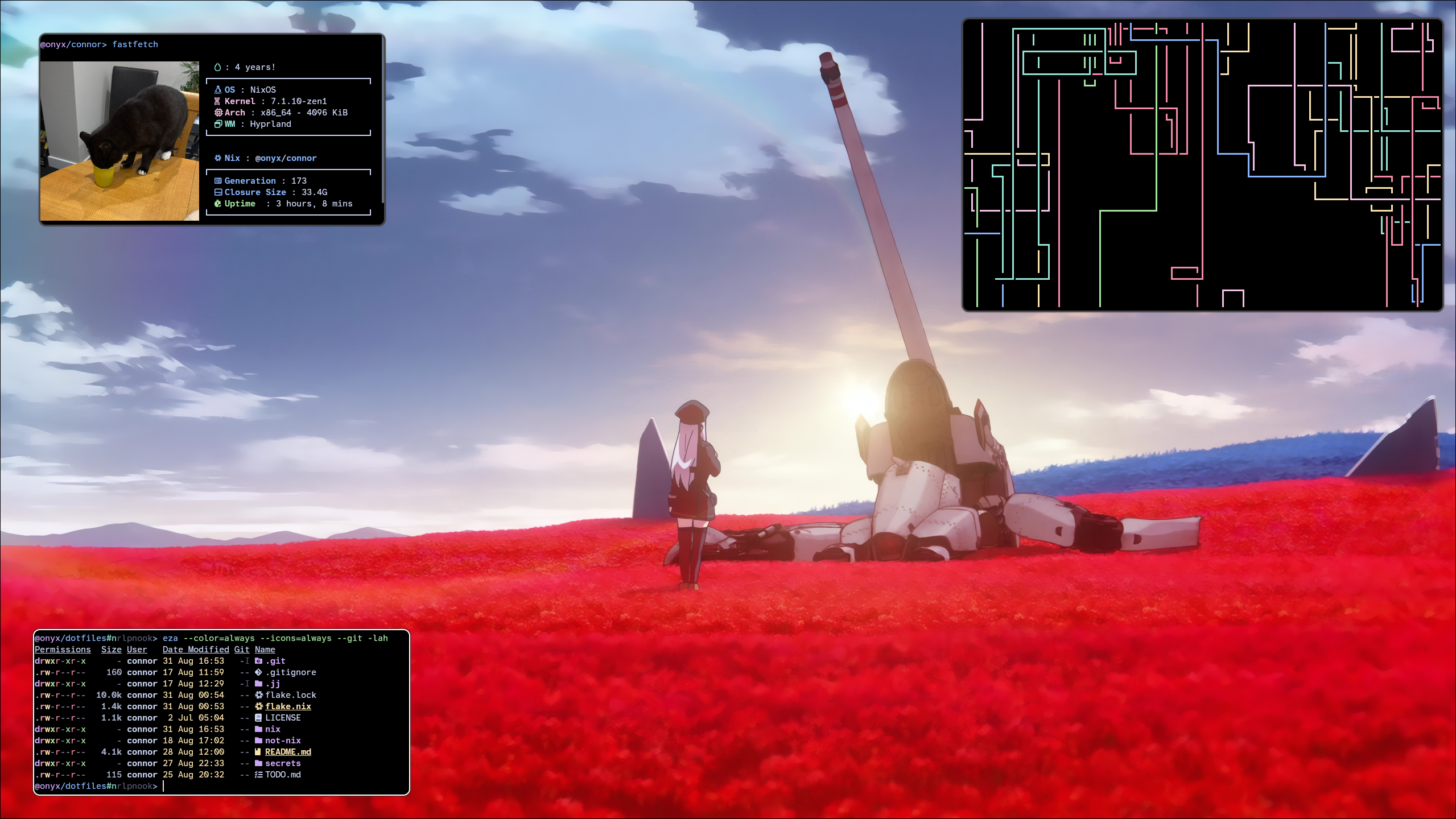
I have a very minimal style no bars, no panels only the background and an app launcher. All my hosts are themed with Catppuccin Mocha, oled variant but the dots themselves support inserting different themes... in theory.
Architecture
This is a "dendritic" flake: almost every file under nix/ is a small,
self-contained module that attaches itself to the flake's output tree, rather
than being wired together by hand in flake.nix.
import-tree
flake.nix only does one interesting thing:
outputs = inputs: inputs.flake-parts.lib.mkFlake {inherit inputs;} (inputs.import-tree ./nix);
import-tree walks nix/ and imports every .nix file it finds as a
flake-parts module. This means adding a new host, hjem module, or NixOS module
is usually just "add a new file" — nothing else needs to know it exists.
One file, one concern
Host specific modules are generally named <host>-config.nix,
<host>-hardware.nix, <host>-hjem.nix, <host>-disko.nix, and combined in a
small default.nix that calls nixpkgs.lib.nixosSystem. Shared building blocks
(defaults, hyprland, oledppuccin, and so on) live in their own files and
are pulled in by name.
Registries: hjemModules, nvfModules, secretModules
Three custom flake-parts options act as registries for reusable pieces:
flake.hjemModules— reusable hjem user configuration, tagged with_class = "hjem"so it can beimports-ed by name from any host'shjem.users.<name>.flake.nvfModules— reusable Neovim configuration, tagged_class = "nvf", composed together in thenvim-qwertypackage (see the NVF Modules page).flake.secretModules— optional, per-usernix-secretsdeclarations. See the Secrets page for why these are kept separate from the maindefaultsmodule.
Each registry is defined once, using flake-parts-lib.mkSubmoduleOptions, and
every other file just adds entries to it, e.g.
flake.hjemModules.connor = { ... };.
Composing a host
A typical host file looks like:
flake.nixosConfigurations.<host> = inputs.nixpkgs.lib.nixosSystem {
  modules = with self.nixosModules; [
    defaults
    hyprland
    limine
    <host>-config
    <host>-hardware
    <host>-hjem
    # ...per-user modules (connor, kyla, aude, ewan, leo)...
  ];
Secrets
Secrets are managed with nix-secrets, an age-based secrets module. Two things are worth understanding before touching it: recipient aliases, and why secrets are split into per-user modules.
Recipient aliases
security.nix-secrets.recipientAliases (set once, in defaults) maps a host
name to its age public key, plus an all-hosts alias covering every real
machine. Each secret declares which aliases can decrypt it via recipients,
e.g.:
security.nix-secrets.secrets."connor/linux" = {
  neededForUsers = true;
  recipients = ["ACE" "cookie" "lenix" "murtle" "onyx" "turtle" "yubikey"];
};
hostRecipientAlias (from the secret-assertions module) lets a host use a
different alias than its networking.hostName, though every current host uses
its own hostname.
Why secrets are split per user
nix-secrets attempts to decrypt every secret declared for a host's evaluated
config, regardless of whether that host is actually a recipient — a host that
isn't listed still fails activation instead of just skipping the secret. To
avoid every host trying (and failing) to decrypt secrets for users it doesn't
have, each user's secrets live in their own flake.secretModules.<user> entry
(connor, connor-eduroam, ewan, kyla, aude), and only the NixOS modules
for hosts that actually have that user import the relevant one — e.g.
self.secretModules.connor is only imported by the connor NixOS module, which
in turn is only imported by hosts with a connor account.
connor-eduroam is a good example of splitting even further: it holds a single
secret (connor/wifi/eduroam) scoped to lenix and yubikey only, because no
other host needs eduroam credentials.
secret-assertions
The secret-assertions module (flagged in its own source as AI-generated — read
it carefully before changing it) runs at evaluation time and fails the build,
rather than failing silently at activation, if:
- the host's recipient alias isn't present in
recipientAliases, or - any secret declared in that host's config lists recipients that don't include the host's alias (i.e. a secret that would fail to decrypt at runtime).
This turns a runtime activation failure into a build-time error, which is the
main reason to prefer importing scoped secretModules over adding secrets
directly to defaults.
escapepod3 is the exception
escapepod3 explicitly disables nix-secrets
Building these docs
You can use the provided .envrc or manually enter the docs devshell with nix develop. Run each of these commands in a seperate terminal:
darkhttpd build
watchexec --exts md,css,toml -- ndg html